Showing posts with label Product Review. Show all posts

Thursday, January 5, 2012

Pocket Projector for iPhone - the next coaching tool

I have recently purchased the Brookstone Pocket Projector for iPhone.  It took me about 4 trips through various airports before I pulled the trigger on the $229 device, but I have found it useful for day to day coaching and technique work.

It comes in handy for videoing swimmers during practice.  The images from the projector can go as large as 50 inches before they get too grainy for use.  I find it works well for groups, or for swimmers whose vision is poor.

The biggest trick is to find a darker area, in/around the pool deck to make it useful.  At our pool, we have a darkened entry way with a big bulletin board that works perfect as a projection area.

The kids like the fact that they don't have to look over my should to get a view of their strokes and technique.  It even has a fairly good set of speakers on it.

I have used it to project Netflix and YouTube videos, and it can also be used to project presentations and photo albums.

The drawbacks to the unit are:

  • it is a little big to use as a permanent iPhone case.  I usually just slide my phone in as needed.
  • it does not have an adjustable stand.  If you are using it for presentations, or as a stationary projector, you may need to prop it up on some books to make it the right height for your "screen"
  • the $229 price tag is a little hefty.  I definitely had to do some soul searching before I bought it.
All in all, I think it is a worthy purchase...at least for me.

Monday, October 3, 2011

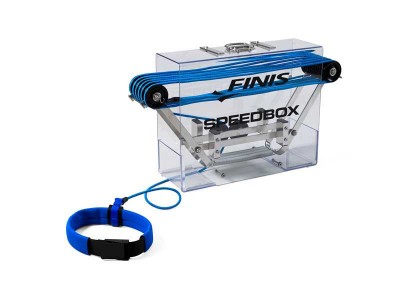
Finis SpeedBox

Back when I was coaching on a previous team, and they had plenty of cash, we had one of the most amazing devices ever...the Power Reel, by Total Performance.  With a price tag, including shipping, of nearly $3000, it is a bit out of my price range now.

Enter the Finis SpeedBox.  At a price tag of around $650, including shipping, it is a much more affordable option.  Although it is not nearly as sophisticated a device, perhaps it's weight and portability make up for it.

The SpeedBox is a resistance training and sprint assistance training device that is a big step up from Stretchcordz brand bands.  The spring, pulley, and bungie system provides a much more even tension over a greater distance than bands.  The belt and hook come with a neoprene cover that provide much more comfort for the swimmer.  The SpeedBox sits on top of your block and has two anchors to hold it in place.

I did not really have too many criticisms of the SpeedBox save one.  It is not easy to get the clasp completely applied.  There were several time during our inaugural use of the Speedbox, when the clasp came loose and the belt came off.  Every time, this happened during the initial push off.

So far I have used it for sets of quick 10 second sprints as well as 25yd assisted sprints.  It has worked well for both.  Overall, I would give the Finis SpeedBox two thumbs up.  It is hardly a cheap purchase, but it seems sturdy and may be a better long term purchase than bands.

Wednesday, September 28, 2011

Tempo Trainer Pro - A great upgrade!

I really enjoyed the old Finis Tempo Trainer.  The digital metronome had two major flaws:

  • the battery was not replaceable
  • if you were using the trainer for pacing, you could not reset it for the start of a rep.
The newest version addresses both of these flaws, and make the trainer much easier to use, and it increases it's lifespan.
The Tempo Trainer Pro has the familiar two button system below the readout.  The two buttons turn the trainer on/off, and allow you to adjust the metronome.  The top button is a reset button that restarts the metronome cycle.  Why would you want to do this?  For pace work.

My favorite use of the Tempo Trainer Pro is as a pacing device.  If you have a swimmer that needs to be pacing 50's at a :30.2 second pace, you can simply set the metronome at :15.1.  At the start of each 50, the swimmer can tap the reset button.  To stay on pace, the simply need to turn at/before the first tone, and then finish on the second tone.  I think this use is ideal for teaching a swimmer how to pace a middle distance to distance race.

Of course, the Tempo Trainer Pro can be used to work on stroke rates.  Set the metronome down to anything from .01 seconds on up.  The precision is great.

All in all, the upgrade is just what the coach ordered.  The price tag is a bit high at $49.99, but I expect the price will go down once it is available from vendors other than just the manufacturer.  For now, you can order yours at finisinc.com.

Thursday, August 18, 2011

Battling Ropes for Dryland Training - Product Review

At the beginning of the summer, I stumble across some Ryan Lochte dryland training videos.  Specifically, I found a battling rope video:


I had never seen this kind of training, but I was intrigued.  This kind of resistance training is different than any other dryland training I have offered in my coaching career.

I have done lots of weight training.  But weight training is a constant resistance.  I have done lots of bands training, but training with tubing and bands has an exponential component.  Training with ropes has an incremental component.  the more rope you move, the more challenging the exercise.  With weights there is no change, with bands the resistance is not constant.  Rope is just right.

This month I purchased a couple of 40 foot, 1.5 inch battling ropes to see if there was something new I could offer my swimmers.  The feedback is very positive...which means the swimmers "hate" it.  Actually, they really like the new challenge.  There are lots of videos available online for different exercises, so I am able to offer lots of variety in our training.

I am decided that including rope training in our dryland circuit training is the best approach to incorporating rope training in our training.  If I could afford a dozen ropes, I would probably approach rope training differently, but I could only afford a couple.  Toss those in with some TRX straps, bands, jump ropes, etc. and you have a pretty dynamic dryland set.

I bought my ropes at Perform Better online.  Click here to see what I ordered.  It works, and it is just the variety my kids crave.  Two thumbs up!

Wednesday, August 17, 2011

StrengthsFinder 2.0 - Book/Product Review

I was listening to the Dan Fagan Show on AM KBYR/TV KTBY, a local talk/TV show, last week while he had a business coach on as a guest.  She was talking about utilizing each employee to the fullest by determining what their personal strengths are, and then tapping into those strengths.

She referred to the book StrengthsFinder 2.0 by Tom Rath and the associated Clifton StrengthsFinder 2.0 personality test.  The test is around 170 questions and takes about 30 minutes to take.  At the end of the test you are given a report with your results.

The 18 page report lists your 5 primary strengths and then explains the traits for each strength.  It goes on to  help you determine an action plan to highlight your skills and then on to show you feedback from others who share your top 5 themes/strengths.

I really like the idea of the entire book/test.  I am in the process of having some assistant coaches take the test so that I can have some greater insight when working with them.  My hope is that I can make the team more successful by using the staff's talents to their fullest.  I am considering having my entire staff take the test and maybe even prospective employees.

The StrengthsFinder 2.0 book contains all the information for each of the strengths/themes identified in the test.  The online test requires an access code which is only available in the back of each book, and it is only good for one use.  This means a book for each staff person.  It would be nice to be able to just purchase additional access codes for the test, but this is the only negative I have regarding the book and test.

StrengthsFinder 2.0 is available at Amazon.com for around $14 in hardcover or $13 for the Kindle version.  If you scroll through the carousel widget at the top of this post for the most recent Amazon prices.

Sunday, June 26, 2011

Finis Swimmer Snorkel in Butterfly

I have used the Swimmer's Snorkel, by Finis, for many years as a breath control and stroke technique device.  I have used it mostly in Freestyle, a little in Back and Breast, but very little during Fly.  Last week I observed on of my college swimmers using one for an entire set of fly.  I had to ask her about it afterward to see what her thoughts were.  She said it allowed her to swim more fly through a set without breaking down.  I however, noticed something more, but thought I would give it a more thorough try with a larger group...my senior boys.

Last Friday I gave a set of 25's Fly with snorkels and fins.  Throughout the set I encouraged the boys to keep their stroke profile, there stroke undulation, as tight as possible.  I really wanted to encourage them to engage their core more in the process of each stroke cycle.  When you have the snorkel on, you don't have to recover up to get a breath, but it also encourages a shallower downward motion as the hands are driving forward.  Undulate too deep, and your snorkel fills.  Recover to high, and you may as well not have on a snorkel because your face will be out of the water.

It was a real challenge for some of the boys to tighten up that body undulation.  However, once they got the hang of it, they began to use there core muscles (abs, lower back, upper legs) more in during each stroke cycle.  They were using there heads and arms less, and using their core more.  The result was more forward velocity in each stroke and fewer strokes per length.

I am sold on using the snorkel for fly, and encourage you to give it a try.

Wednesday, June 15, 2011

Warming up Aussie style; Finis Swimmer's Snorkel & TYR Catch Paddles

A couple of weeks ago I was watching and interview, on Floswimming.org, with some coaches of the Australian National Team.  The Aussies were training in Tucson and tuning up for the Santa Clara International.  One of the coaches, who was working with the distance/mid-distance group, had the swimmers warming up with a snorkel, paddles, and a buoy.

I grew up with coaches that avoided using paddles during warm-ups.  They were afraid of shoulder injuries that could occur with the added stress of the paddles on the cold shoulder muscles.  However, after watching the Aussie distance swimmers I decided to take give it a shot.


I primarily work with HS age boys, some of whom are small enough that a buoy would actually mess with their body position, so I avoid using the, but I do have some Finis Swimmer's Snorkels and some TYR Catch Paddles.  I have liked using the snorkels  to, among other things, allow for a smoother, more connected, stroke, and I like the catch paddles because they promote an extended stroke and proper catch without putting much strain on the shoulders.


By giving the boys a long warm-up with an easy-to-moderate interval, they can relax into some beautiful strokes right at the beginning of practice.  By the time they complete it, they have essentially done a long technique swim without much fuss.  I have been using the snorkel/paddle combination in warm-ups for about 2.5 weeks now, and I am liking the results.  The guys are able to keep their strokes in-line/connected and are able to establish a nice catch early in the practice.

Watch the video, listen to Coach Vince Raleigh, consider giving it a try.


Saturday, June 11, 2011

Finis Swim Mirror - Seeing is Believing

I recently purchased the DVD from GoSwim.tv featuring Steve Haufler...it is a great video filled with great tools, methods, and progressions.  I plan to review the DVD soon, but in the mean time I want to write about one of the tools Steve Haufler uses regularly throughout the video; mirrors.

Finis Inc manufactures mirrors for placement on the bottom of the pool while working on swimming skills.  The 45.5"x28" polished aluminium mirror weighs about 3 pounds and is easy to place on the bottom of the pool so your swimmers can see themselves as they pass or hover over it.

I have been using the mirrors to encourage my learn to swim students to do anything from put their faces in the water, to working on proper stroke technique and body position during freestyle and breaststroke.  If you put several mirrors in a line, they would be appropriate for more advanced swimmers as they work on hand placements, etc.

The mirrors themselves are pretty sturdy when in the water and in the bottom.  Having said that, you want to be careful when putting them in the water and taking them out.  Aluminum can bend, bow, and be dented easily.  Small dings won't make much of a difference, but avoid dropping or banging the mirrors about.

Finis sells the mirrors for around $105, but you can find them for around $10-$15 cheaper at amazon.com.  All in all, a pretty good investment for swimmers and learn to swim students.  Definitely worth the small investment.

Saturday, May 21, 2011

Finis PT Paddles

If you are looking for a way to increase sensitivity or "feel" for the water the Finis PT (Perfect Technique) Paddle might be your solution.  The paddle is designed to improve your stroke efficiency by heightening your feel for the water, especially during the catch phase of each stroke.

The concave shape of the paddle surface encourages improved hand and forearm pitch during the stroke.  While wearing the paddle you engage your catch with the forearm earlier in the stroke.

Once the paddles are removed the sensitivity of your palm in increased and your ability to feel the water is improved.  This is the perfect time to work on distance per stroke.  Your sensitivity will make your catch feel as if you have more traditional paddles that increase your hand's surface area.

At $30 a pair, they are a bit more expensive than a traditional paddle.  With that said, they offer an ease of use that surpasses products like the UFG (Ultimate Fist Glove).  However, a pair of tennis balls, one held in each hand, might be just as useful.

Thursday, May 19, 2011

Manikins for swimming demonstration

I have recently been working hard to convey a specific skill to my swimmers.  I have used video, demonstrators, multiple ways of describing the skill, but was still not quite reaching them.  Then I remembered my assistant Woody.

Woody is a 12" wooden manikin that I originally purchased about 6 years ago.  I was inspired while at a USA Swimming Select Camp in Colorado Springs.  Former Resident Team Coach, Jonty Skinner was using one to demonstrate various body positions and techniques.  It worked great for me.

Since then I have found that I can usually count on Woody to lend yet another visual tool for the swimmers to see the skill in 3D.  When standing on deck it is not always possible to adequately describe or even demonstrate the skill you are trying to convey.  The simplest example I can think of is turns.  It is simply not possible to demonstrate a complete turn while standing on deck.  However, pull out your wooden manikin, and you can do it with ease.

Try showing your swimmers proper body roll in freestyle and backstroke while standing vertically on deck.  With the manikin, you can demonstrate the roll in the proper orientation for the swimmers to better see what it is you are describing.

Manikins of various sizes are available for about $10 on amazon.com and are light enough to keep in your coaching bag...right next to your stop watch.  It's like having an extra coach in your bag.

I have even recently ordered a manikin head to keep at the pool.  I plan to put a team cap and goggles on it and use it for my learn to swim and novice swimmers.  I think it will be a great way to help kids learn the proper head positions in each stroke.  A coach or instructor can hold the manikin head in the proper position and still be able to talk to the swimmers.  These are also available on amazon.com, but are not really the right size for your coaching bag...you will probably want to keep it at the pool.

Sunday, April 24, 2011

FInis Swim Parachute - Product Review

I recently had the opportunity to test the Finis Swim Parachute.  The Swim Parachute is a simple resistance training device that can easily be used during the course of a normal practice.  While I don't like using the parachute for aerobic training, it comes in handy for speed/power training.

I have used several devices in the past, including drag suits, stretch cordz, power racks, and the Power Reel.  The Swim Parachute is easily the most cost effective method of resistance training in our sport.  It provides consistant and even resistance throughout the exercise.  Of course, the fast the swimmer, the more the resistance, but that is physics.

Unlike stretch cordz, the Swim Parachute provides stable and constant resistance.  Unlike the power rack or reel, it provides this resistance at a reasonable price.

At around $24 it is the perfect item to include in a training bag.  It comes in 8 inch and 12 inch models.  See www.finisinc.com for more information.

During my most recent use, I had my senior boys swim four 12.5 yard sprints on a :30 interval.  The first three were swum with the 12 inch parachute.  The fourth sprint was without the parachute.  Every single swimmer was able to feel his speed better on the fourth sprint.  I think it is akin to wearing ankle weights all day and then taking them off....you feel lighter and more at ease.  Just one of the uses of the Swim Parachute.

Thursday, April 21, 2011

The Science of Swimming - James E. Counsilman

When I was in Jr. High my father gave me a wonderful gift...a book by James "Doc" Counsilman, The Science of Swimming.  The book was written in 1968 and the information within those pages is a salient today as it was when it was written.  On the recommendation of Guy Edson (ASCA) I recently re-introduced myself to the original reference book of the sport of swimming.

Virtually every aspect of the sport of swimming is covered in the volume.  With some exceptions on body position, much Counsilman's details on each of the strokes as well as starts and turns are still very much as are being taught today.  The much of artwork and photography in the book could be used in any swim text today.

The methods of training in the book include interval training (cutting edge methodology at the time), dryland training, and progressions within a season.  In his detailed writing he gives example sets, exercises, etc used in his program at Indiana.

Counsilman covers season planning, Age Group swimming, educational concepts, nutrition, even motivation of swimmers.  Fundamentally speaking, this book is as sound as any swimming text.  There have been others (Maglischo & Colwin) who have written other great swimming books but, in my opinion, Councilman's remains the seminal work on the sport.

I strongly encourage you to acquire a copy.  I found a few copies at Amazon.com that I am giving to my staff, but the book is no longer in print.  If you want to add a copy to your coaching library I wouldn't wait too long.

Sunday, March 27, 2011

TYR Catch Paddle


The TYR Catch Paddle is a finger paddle that has an enlarged side "fin". The overall shape of and size of the paddle allows a feel for the water while encouraging the proper hand position at the front of the stroke. The large fin creates an exaggerated catch in each stroke.

How does the paddle encourage proper hand position and an exaggerated catch? Well, the increase in surface area and shape of the extended fin create an awareness of what the hands are doing at the front of the stroke. For example, if you enter the water too much toward the thumb on the freestyle, the paddle may just tear itself from your hand, or force your hand deep and across your center line. However, if you enter correctly, your hand will be driven forward.

If you are looking for a tool that will help with the catch phase of your strokes (or your swimmer's strokes), this will definitely help. It comes in 4 different sizes, so it should not be hard to find one that works for you. TYR does have some user recommendations for each of the sizes offered. In general, I have found that the yellow (small) paddles work well for my 10-13 year olds, while the red (medium) paddles work well for my high school swimmers. I am even considering getting some green (x-small) paddles for my youngest swimmers.

Bottom line: I think the TYR Catch Paddles are a great technique tool for swimmers of all ages. I found them as low as $10 which is very affordable. Every swimmer should have a pair in their swim bag.

Thursday, December 18, 2008

Product Review; CoachCam

Underwater video of swimming is invaluable when evaluating stroke technique. Underwater video has come a long way since I started coaching. We used to have to video from a small room under the pool where the small window was positioned. Then we had the periscope type of video. Periscopes provided nice enough video, but they were clumsy and immobile. Now we have the cameras that actually go beneath the surface. The industry leading underwater camera is the CoachCam from the Underwater Camera Company of America.

The CoachCam is a relatively simple looking device. There is the camera at the end of a telescoping pole that connects to a control box. The box contains the batteries and the video out port that connects to your recording device (typically a hand held type of camcorder). The camcorder is positioned atop the pole on mono pod type of camera platform. The entire CoachCam is light and easy to hold or even move through the water for great underwater video of swimmers.

Once you are finished recording, you can connect your camera to a tv, computer, etc. to review the video with the swimmer. We personally use a laptop computer to review the video. It is simple to upload and then manipulate the video while viewing. We can even burn a DVD for the swimmer to take home.

The CoachCam is available for purchase through the website of the Underwater Camera Company of America. There are a couple of models with a few options. We use the base model and it works great!

Saturday, September 13, 2008

Product Review; Finis Tempo Trainer


The Tempo Trainer, by Finis, is a small personal swimming metronome. The device is not much more than an inch in diameter or 1/3 of an inch thick. It has a small digital readout and two buttons to adjust it's function. The Tempo Trainer is affixed to your goggles or under your cap and emits audible chirps and beeps. These beeps represent signals to the athlete for either stroke tempo or pacing. The device is relatively simple to use and has two modes.

The first mode is used for setting stroke and stroke cycle tempos. Rates can be set between .20 seconds and 9.99 seconds. The second mode is used for setting lap, distance, or interval paces. It can be adjusted from 9.99 seconds to 9.59 minutes.

I have used The Tempo Trainer in both modes with athletes that I have trained and found it to be useful in both modes. That being said I especially like the 2nd mode. I like using the device to let a swimmer know if he or she is on pace during sprints. Simply set the device for the goal time or intermediate split time, and a swimmer gets immediate feedback on whether or not he/she is achieving the time just by hearing the beeps. You can tell a swimmer to leave on a beep and to try and beat the next beep. It is great!

The only drawback to this device is that it is difficult to use with more than two or three athletes as a time. Having said that, I believe that it is a good coaching and workout tool. The Tempo Trainer is a great item to have in your coaching or swim bag.

The Tempo Trainer lists at $31.99, but can be found for as low as $23.95.

Saturday, September 6, 2008

Book Review; Maglischo's "Swimming Fastest"


Ernest W. Maglischo's Swimming Fastest is his third iteration of the ultimate competitive swimming reference. Swimming Fastest (2003) was preceded by his Swimming Faster (1982) and his Swimming Even Faster (1993). Much like his first two books, the huge volume is broken into three parts: Technique, Training, and Racing.

In this third version Maglischo has made many updates to his previous works. Most of the changes have come in the Technique part of the book. Maglischo had promoted a theory of swimmer propulsion based on the idea that athletes were using their hands and limbs like foils, or even propellers, through the water. In Swimming Fastest, Maglischo, has modified his theory to account for recent research that suggests athletes use their limbs like paddles to push water backward, thus propelling them forward. As someone who had read Swimming Faster and Swimming Even Faster, I must say I am relieved that he has modified his stance. I never found the foil theories of lift and propulsion very intuitive. The Technique portion of the book uses the laws of physics, graphs, diagrams, and his descriptive text to throroughly cover every stroke, turn, and start.

The Training portion of Maglischo's book may be the most useful. It is filled with scientific explainations of muscle fibers, the circulatory system, and the repiratory system. It covers the effects of training and suggests methods and volumes for training the various energy systems thought to be in use during workouts and competition. It is written for the science buff and the layman alike.

The final and smallest part of the book is Racing. In Racing Maglischo covers the importants of warm-up/cool down as well as race pacing and strategy. He also covers evaluation techniques including calculating stroke rates and stroke lengths.

It is impossible to give more than a cursory overview of this all-in-one manual. It is truly a must for any coach's library. As it says on the cover of Swimming Fastest: "The essential reference on technique, training, and program design"

Monday, September 1, 2008

Book Review; Guzman's "The Swimming Drill Book"


The Swimming Drill Book by Ruben Guzman, and published by Human Kinetics, is a concise and well illustrated compilation of 128 swimming drills. Drills are broken down into 10 Chapters:
  1. Body Position and Buoyancy
  2. Breathing and Kicking
  3. Sculling
  4. Backstroke
  5. Freestyle
  6. Breaststroke
  7. Butterfly
  8. Freestyle and Backstroke Turns
  9. Other Turns and Finishes
  10. Starts
Guzman has done a good job pulling together drills from many of the masters of competitive swimming. Experienced coaches will recognize drills that have been created and/or promoted by Boomer, Colwin, Maglischo, Hannula, and others. In addition there are several drills that seem to come directly from Guzman himself.

New and experienced coaches, as well as swimmers, will find The Swimming Drill Book a great reference for their coaching library. Guzman's book is a tool box coaches will be able to draw from to help teach and correct form and stroke technique. 4 1/2 out of 5 stars for The Swimming Drill Book!